Formats and rules

Padel scoring, explained

Padel is scored like tennis. Points go 15, 30, 40 and game; the first pair to win 6 games with a two-game lead wins the set, and at 6–6 a tie-break to 7 points decides it. A match is usually the best of three sets. At 40–40 (deuce) there are three ways to finish the game: advantage, the golden point, or the star point that the FIP rules added in 2026.

Keep score in your browser

Points and games

The first point a pair wins in a game is called 15, the second 30, the third 40, and the fourth wins the game. The server’s score is called first, so “30–15” means the serving pair has two points and the receivers one.

Points go 15, 30, 40, then game. The serving pair’s score is called first.

At 40–40: advantage, golden point or star point

When both pairs reach 40 the score is deuce. The FIP rules allow three ways to go on; agree on one before the match.

Advantage

The pair that wins the next point has the advantage. If they win the point after that too, they win the game; if not, it is deuce again. A pair needs two points in a row.

Golden point

At deuce one deciding point is played, and whoever wins it wins the game. The receiving pair chooses whether to receive on the right or the left side, and they cannot swap places for that point. In a mixed match, the player who receives is the same sex as the server.

The receivers' half of the court, with its two service boxes, left and right. At the golden point the receiving pair chooses which box to receive in. Right and left are as the receivers see them, facing the net. Right Left The receivers choose a box Net
At 40–40 one point decides the game. The receiving pair picks the left or the right box, and the one who receives cannot swap with the partner for that point.

Star point (FIP rules from 2026)

The star point sits between the two. At the first deuce you play advantage; if the game comes back to deuce, you play advantage a second time. If it comes back to deuce a third time, one deciding point, the star point, wins the game, with the same choice of side as the golden point.

At 40–40: advantage goes on until a pair wins two points in a row; the golden point is one deciding point; the star point plays advantage twice, then one deciding point at the third deuce. Advantage Deuce Adv. Deuce Adv. … Game Win two points in a row. No limit. Golden point Deuce Game One point decides. The receivers choose the side. Star point Deuce 1 Adv. 1 Deuce 2 Adv. 2 Deuce 3 Game Advantage twice, then one deciding point.
Dark: the deciding point. With the golden point and the star point, the receiving pair chooses whether to receive on the right or the left.

Sets and the tie-break

The first pair to win 6 games with a lead of two wins the set. At 5–5 you play on to 7–5. At 6–6 a tie-break decides: points are counted 1, 2, 3, and the first pair to 7 with a two-point lead wins the set 7–6.

In a tie-break the player whose turn it is serves one point, from the right. Then each player serves two points in turn, and the pairs change ends every 6 points. The next set starts with the other pair serving.

A set ends 6–4 or better, 7–5, or 7–6 after a tie-break at 6–6. 6–4 Six games, a 2-game lead 7–5 At 5–5, play to 7 7–6 At 6–6, a tie-break
A tie-break goes to 7 points with a two-point lead; the winners take the set 7–6. A super tie-break goes to 10.

The match and the super tie-break

A match is usually the best of three sets: the first pair to win two sets wins. To save time, many tournaments replace the third set with a super tie-break: at one set all, one tie-break to 10 points, with a 2-point lead, decides the match. Shorter formats exist too, such as one set, or sets to four games.

Changing ends

The pairs change ends after the 1st, 3rd and every odd game of a set, and every 6 points in a tie-break. Between points there are at most 20 seconds, and at a change of ends at most 90.

All of this follows the FIP Rules of Padel, applied from 1 January 2026. The official text is on the FIP documents page.

Americano and Mexicano scoring is different. These social formats count every rally as one point, without games or sets: see Americano.

GuideEvery padel shot explained: 26 shots, from the serve to the x4
Do this in the app

Live scores, live table.

  • Live scores on every phonePlayers tap the points in on their own phone. The table updates at once.
  • One invite linkPlayers add themselves, say “I’m in” and see their first match. No account.
  • The big screenCourts, scores and the table on the club TV, live.
Get the app

On the App Store now. Android is in testing: join free.

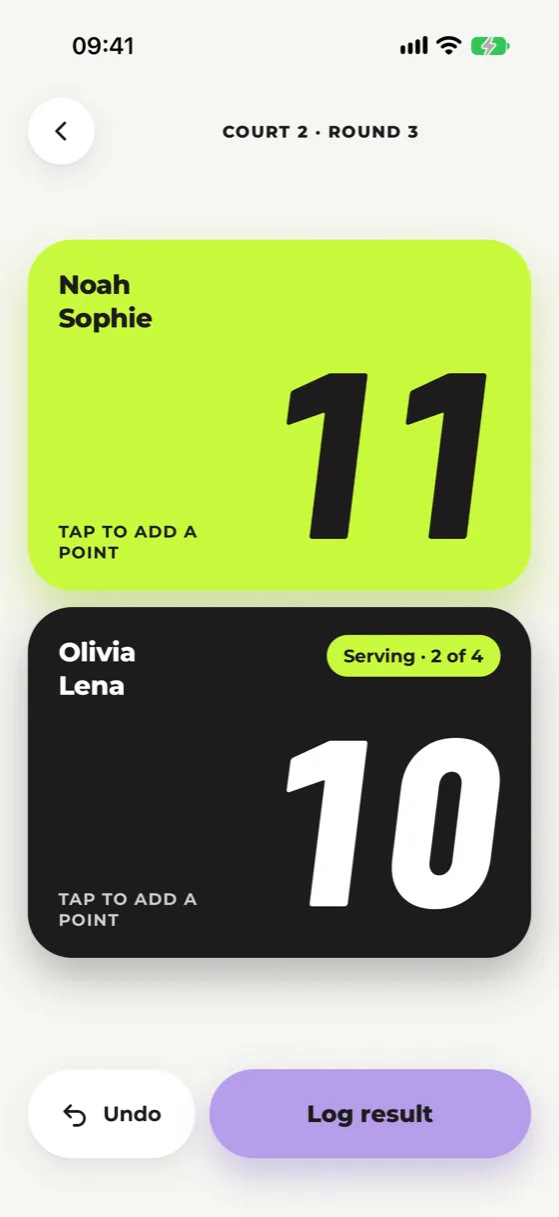
The app’s live scoring: one tap per point

Questions people ask.

How does padel scoring work?

Like tennis: points go 15, 30, 40 and game, 6 games with a two-game lead win a set, and at 6–6 a tie-break decides it. Most matches are the best of three sets. At 40–40 your group plays advantage, the golden point or the star point.

What is the golden point in padel?

At 40–40 one deciding point is played: whoever wins it wins the game. The receiving pair chooses whether to receive on the right or the left, and they cannot swap positions for that point.

What is the star point in padel?

A rule in the FIP Rules of Padel applied from 1 January 2026. At deuce you play advantage, but only twice: if the game comes back to deuce a third time, one deciding point, the star point, wins the game. The receiving pair chooses the side, as with the golden point.

How does a tie-break work?

At 6–6 in a set, the points are counted 1, 2, 3. The first pair to 7 points with a two-point lead wins the set 7–6. The first server serves one point, then each player serves two points in turn, and the pairs change ends every 6 points.

What is a super tie-break?

A tie-break to 10 points, with a 2-point lead, played at one set all instead of a third set. It is common in club tournaments because it saves time.

When do players change ends?

After the 1st, 3rd and every odd game of a set, and every 6 points in a tie-break.