Padel tournament formats, explained
Padel tournaments come in two kinds. Social formats such as Americano and Mexicano mix the pairs and count points, so everyone plays every round. Competitions are played by fixed pairs with sets and games: first in groups where every pair meets every other pair, then in a knockout where the loser of each match is out. With many pairs, the competition is a knockout from the start, with the strongest pairs seeded and byes filling the empty places.
Social formats: everyone plays every round
For a group of friends or a club evening, the social formats keep everyone on court. Matches are short and counted in points, one point per rally.
- Americano: your partner changes every round.
- Mexicano: the table decides who plays together, so the matches stay close.
- Team Americano: fixed pairs, every pair plays every other pair.
Not sure which one? The format finder shows each one for your players, courts and time.
Competitions: groups, then a knockout
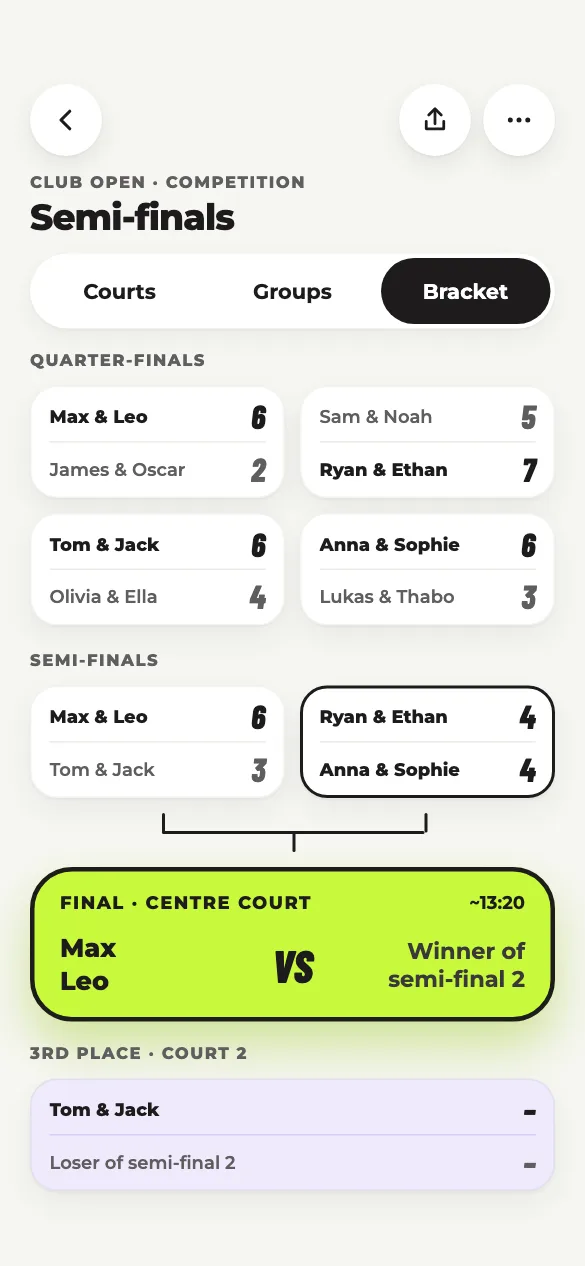
A competition is played by fixed pairs with real sets and games. With up to 16 pairs, the pairs are drawn into groups of 3 to 5. In a group every pair plays every other pair once. The best pairs of each group go through to the knockout, where the loser of each match is out and the winners move on to the final.
- 4 or 5 pairs: one group; the top two play the final.
- 6 to 8 pairs: two groups; the top two of each play the semi-finals.
- 9 to 11 pairs: three groups; the three winners and the best runner-up play the semi-finals.
- 12 to 16 pairs: four groups; the top two of each play the quarter-finals.
The group table
The pair with the most wins goes first. If two pairs are level, the match between them decides. If three are level, the difference of sets won and lost in the matches among them decides, then the difference of games, and if they are still level, a draw of lots.
A knockout from the start
With more pairs, or less time, the competition is one bracket. A bracket has 4, 8, 16 or 32 places. The strongest pairs can be seeded: seed 1 starts at the top of the draw and seed 2 at the bottom, so they can only meet in the final; seeds 3 and 4 are drawn onto the two places in the middle. The other pairs are drawn into the free places.
With fewer pairs than places, some places stay empty. A pair facing an empty place has a bye and goes straight to the next round. The top seeds get the byes first, so they are rewarded for being seeded.
Walkovers and retirements
Under the FIP rules, a pair that is not on court ready to play 10 minutes after the start time loses by walkover (W.O.); it counts as 6–0 in every set needed. A pair that has to stop during a match retires: the sets played stay, and the rest go to the other pair.
Match formats
- Best of 3 sets: the classic, about 90 minutes a match.
- 2 sets and a super tie-break: at one set all, a tie-break to 10 points decides; about 65 minutes.
- One set: six games with a two-game lead, a tie-break at 6–6; about 35 minutes.